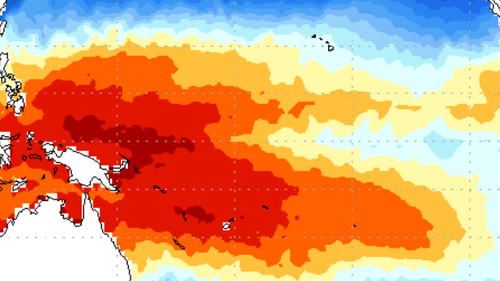
<div class="block-content"><div class="styles__Container-sc-1ylecsg-0 goULFa"><span>Meteorologists are forecasting that a relatively weak spell of </span><a href="https://www.9news.com.au/la-nina" rel="" target="_blank" title=" La Niña"><span>La Niña</span></a><span> is on its way out, with a growing possibility of the first El Niño event in almost three years to follow shortly after.</span></div></div><div class="block-content"><div class="styles__Container-sc-1ylecsg-0 goULFa"><a href="https://www.9news.com.au/national/la-nina-bureau-of-meteorology-makes-declaration-ahead-of-summer/920752e4-4e59-4c16-9cd1-297d3fd590b9" rel="" target="_blank" title="The Pacific has been experiencing La Niña since November"><span>The Pacific has been experiencing La Niña since November</span></a><span>, which is a period in the El Niño–Southern Oscillation cycle that affects weather patterns worldwide.</span></div></div><div class="block-content"><div class="styles__Container-sc-1ylecsg-0 goULFa"><span>It typically leads to cooler and wetter </span><a href="https://www.9news.com.au/weather" rel="" target="_blank" title="weather "><span>weather</span></a><span> in Australia, but the event has been relatively weak this season. </span></div></div><div><div id="adspot-mobile-medium"></div></div><div class="block-content"><div class="styles__Container-sc-1ylecsg-0 goULFa"><strong><span>READ MORE: </span></strong><a href="https://www.9news.com.au/national/parts-of-qld-set-for-drenching-and-flooding/df1ca282-a73a-4048-bc6f-0da35913b6d0" rel="" target="_blank" title=""><strong><span>Two states brace for floods as weekend downpour looms</span></strong></a></div></div><div class="block-content"><div class="styles__Container-sc-1ylecsg-0 goULFa"><span>The Bureau of Meteorology has forecast that La Niña is weakening even more, with sea surface temperatures falling into the neutral range.</span></div></div><div class="block-content"><div class="styles__Container-sc-1ylecsg-0 goULFa"><span>"Recent warming in the sub-surface suggests further decay is likely in the coming weeks," the bureau said. </span></div></div><div class="block-content"><div class="styles__Container-sc-1ylecsg-0 goULFa"><span>The </span><a href="https://www.9news.com.au/usa" rel="" target="_blank" title="US "><span>US</span></a><span> National Oceanic and Atmospheric Administration also forecast a 75 per cent chance of a transition to a neutral phase by March.</span></div></div><div><div class="OUTBRAIN" data-reactroot="" data-src="//www.9news.com.au/national/weather-la-nia-on-the-way-out-as-experts-flag-possibility-of-el-nio-within-months/d71b613e-c882-4b8e-8053-297da3794460" data-widget-id="AR_5"></div></div><div class="block-content"><div class="styles__Container-sc-1ylecsg-0 goULFa"><span>But it added there was a growing chance of El Niño from March to June.</span></div></div><div class="block-content"><div class="styles__Container-sc-1ylecsg-0 goULFa"><span>"For longer forecast horizons, there are growing chances of El Niño, though there remains uncertainty given the lower accuracy of model forecasts through the spring," the administration said.</span></div></div><div class="block-content"><div class="styles__Container-sc-1ylecsg-0 goULFa"><span>While the Bureau of Meteorology acknowledged that some models suggest a possibility of El Niño developing from June, it was a lot more cautious with its prediction.</span></div></div><div class="block-content"><div class="styles__Container-sc-1ylecsg-0 goULFa"><span>"It should be noted that this is a very long lead time for such a prediction, and forecasts beyond autumn are highly uncertain, as reflected in the large spread across models and within ensemble members," the bureau said.</span></div></div><div class="block-content"><div class="styles__Container-sc-1ylecsg-0 goULFa"><strong><span>READ MORE: </span></strong><a href="https://www.9news.com.au/national/australia-covid-19-vaccine-astra-zeneca-blood-clot-cause/730c03ce-f908-4d0d-a7f8-781534429a85" rel="" target="_blank" title=""><strong><span>Reason why COVID vaccine caused serious blood clots revealed</span></strong></a></div></div><div class="block-content"><div class="styles__Container-sc-1ylecsg-0 goULFa"><span>Monash University's School of Earth, Atmosphere and Environment adjunct professor Dr Andrew Watkins said it was still too early to predict El Niño, and forecasts will become clearer in the coming months.</span></div></div><div class="block-content"><div class="styles__Container-sc-1ylecsg-0 goULFa"><span>"The second half of autumn, things start to become more settled, and it becomes predictions of what will happen for the rest of the year become more accurate," he said.</span></div></div><div class="block-content"><div class="styles__Container-sc-1ylecsg-0 goULFa"><span>The last El Niño event was in late 2023, which was the second-hottest year on record and led to record-breaking temperatures across Australia.</span></div></div><div class="block-content"><div class="styles__Container-sc-1ylecsg-0 goULFa"><span>Watkins said these cyclical events will be intensified by climate change, but are not the only factors leading to extreme weather events in Australia.</span></div></div><div class="block-content"><div class="styles__Container-sc-1ylecsg-0 goULFa"><span>"Globally, we've just had 2025 come in at the third warmest [year] and yet it was La Niña," he said.</span></div></div><div class="block-content"><div class="styles__Container-sc-1ylecsg-0 goULFa"><span>"In the old days, La Niña would give us a cooler year, not the third-warmest.</span></div></div><div class="block-content"><div class="styles__Container-sc-1ylecsg-0 goULFa"><span>"We're moving away from having to have El Niño or La Niña to give us those extremes. Unfortunately, climate change is playing a bigger role every year."</span></div></div><div class="block-content"><div class="styles__Container-sc-1ylecsg-0 goULFa"><strong><span>READ MORE: </span></strong><a href="https://www.9news.com.au/national/angus-taylor-social-media-facebook-post-old-blunder-coming-back-to-haunt-him/bea9a512-565f-4205-a093-49b2dd742536" rel="" target="_blank" title=""><strong><span>Old social media blunder is coming back to haunt Angus Taylor</span></strong></a></div></div><div class="block-content"><div class="styles__Container-sc-1ylecsg-0 goULFa"><span>El Niño and La Niña are part of a natural cycle known as the El Niño–Southern Oscillation and are sustained periods of neutral, warming or cooling in the central and eastern tropical Pacific, according to the Bureau of Meteorology.</span></div></div><div class="block-content"><div class="styles__Container-sc-1ylecsg-0 goULFa"><span>El Niño is associated with warmer weather, while La Niña is cooler.</span></div></div><div class="block-content"><div class="styles__Container-sc-1ylecsg-0 goULFa"><span>The El Niño–Southern Oscillation cycle loosely operates over periods of one to eight years. </span></div></div><div class="block-content"><div class="styles__Container-sc-1ylecsg-0 goULFa"><span>These events occur when sea surface temperatures in the central and eastern tropical Pacific Ocean become substantially warmer than average, disrupting weather across the world.</span></div></div><div class="block-content"><div class="styles__Container-sc-1ylecsg-0 goULFa"><span>In simple terms, Watkins describes it as like "steam off a kettle".</span></div></div><div class="block-content"><div class="styles__Container-sc-1ylecsg-0 goULFa"><span>"The El Niño really is a building up of warm water off South America, and we have cooler water near us, so the clouds form like white steam off a kettle, the clouds form over the warm water in South America," he said.</span></div></div><div class="block-content"><div class="styles__Container-sc-1ylecsg-0 goULFa"><span>"When we get La Niña, the warm water is near us and the cool water is near South America and so we tend to get the clouds forming in our part of the world and it's wetter.</span></div></div><div class="block-content"><div class="styles__Container-sc-1ylecsg-0 goULFa"><span>"The moisture follows the warm water."</span></div></div><div class="block-content"><div class="styles__Container-sc-1ylecsg-0 goULFa"><strong><em><span>NEVER MISS A STORY:</span></em></strong><span> </span><em><span>Get your breaking news and exclusive stories first by following us across all platforms.</span></em></div></div><div class="block-content"><div class="styles__Container-sc-1ylecsg-0 goULFa"><ul><li><strong><em><span>Download the 9NEWS App here via</span></em></strong><span> </span><a href="https://apps.apple.com/au/app/9news/id1010533727" target="_blank"><strong><em><span>Apple</span></em></strong></a><span> </span><strong><em><span>and</span></em></strong><span> </span><a href="https://play.google.com/store/apps/details?id=nineNewsAlerts.nine.com&hl=en_AU&pli=1" target="_blank"><strong><em><span>Google Play</span></em></strong></a></li><li><strong><em><span>Make 9News your preferred source on Google by</span></em></strong><span> </span><a href="https://9.nine.com.au/8x987w" target="_blank"><strong><em><span>ticking this box here</span></em></strong></a></li><li><strong><em><span>Sign up to</span></em></strong><span> </span><a href="https://login.nine.com.au/edm?client_id=nineatnine" target="_blank"><strong><em><span>our breaking newsletter here</span></em></strong></a></li></ul></div></div>
La Niña on the way out as experts flag possibility of El Niño within months
Leave A Reply
Your email address will not be published.*