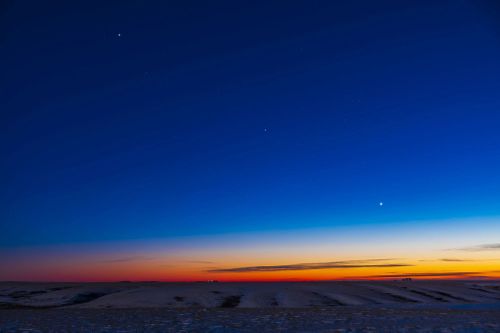
<div class="block-content"><div class="styles__Container-sc-1ylecsg-0 goULFa"><span>Sky-gazers will have the opportunity to see six planets in the sky tonight, weather permitting, according to </span><a href="https://www.9news.com.au/nasa" rel="" target="" title=""><span>NASA</span></a><span>.</span></div></div><div class="block-content"><div class="styles__Container-sc-1ylecsg-0 goULFa"><span>This planetary parade occurs due to the alignment of the planets' orbits around the sun, said Heidi Haviland, a planetary scientist at NASA's Marshall Space Flight Centre in Huntsville, Alabama.</span></div></div><div class="block-content"><div class="styles__Container-sc-1ylecsg-0 goULFa"><span>Mercury, Venus, Saturn and Jupiter will be visible to the naked eye, whereas Uranus and Neptune will require binoculars or a telescope, according to NASA.</span></div></div><div><div id="adspot-mobile-medium"></div></div><div class="block-content"><div class="styles__Container-sc-1ylecsg-0 goULFa"><strong><span>READ MORE: </span></strong><a href="https://www.9news.com.au/world/un-nuclear-watchdog-says-its-unable-to-verify-whether-iran-has-suspended-all-uranium-enrichment/d34e93bd-f7fe-4307-9506-5c027e1c74eb"><strong><span>UN nuclear watchdog unable to verify Iran's suspended uranium enrichment</span></strong></a><strong><span></span></strong></div></div><div class="block-content"><div class="styles__Container-sc-1ylecsg-0 goULFa"><span>Viewers do not have to worry about wearing protective eyewear as they would to watch a solar eclipse.</span></div></div><div class="block-content"><div class="styles__Container-sc-1ylecsg-0 goULFa"><span>The event is visible anywhere on Earth — with best views at twilight. Early birds should try to glimpse the planetary parade before sunrise, and for night owls the best visibility will be right after sunset, Haviland said.</span></div></div><div class="block-content"><div class="styles__Container-sc-1ylecsg-0 goULFa"><span>The best viewing times vary by location, however, she explained via email. The planets need to be roughly 10 degrees or higher above the horizon to be visible. If they are too low, they will be obscured by Earth's atmosphere, she added.</span></div></div><div><div class="OUTBRAIN" data-reactroot="" data-src="//www.9news.com.au/national/space-news-six-planet-parade-will-grace-night-sky/dec6c017-a414-4a24-9eb4-0da84a07c0b7" data-widget-id="AR_5"></div></div><div class="block-content"><div class="styles__Container-sc-1ylecsg-0 goULFa"><span>The planetary parade is a reminder of how planets orbit around the sun and how their positions relative to Earth vary — a key factor scientists consider when planning missions to other planets such as Mars, Haviland noted.</span></div></div><div class="block-content"><div class="styles__Container-sc-1ylecsg-0 goULFa"><span>"The InSight mission had to wait a full year for the Earth & Mars to align to their closet approach so planetary orbits and their position to the Earth play an important role in mission design," she said, referring to the NASA program that sent a robotic lander to Mars in 2018.</span></div></div><div class="block-content"><div class="styles__Container-sc-1ylecsg-0 goULFa"><h3><span>How to tell the planets apart</span></h3></div></div><div class="block-content"><div class="styles__Container-sc-1ylecsg-0 goULFa"><span>Haviland shared a few tips for identifying the planets during the upcoming display.</span></div></div><div class="block-content"><div class="styles__Container-sc-1ylecsg-0 goULFa"><span>"Typically, Venus is the first one that pops up," Haviland said, adding that it will be the brightest object in the sky after the sun and moon, and will have a steady, brilliant white glow on the western horizon after sunset.</span></div></div><div class="block-content"><div class="styles__Container-sc-1ylecsg-0 goULFa"><span>Mars will show up as a red dot, and Saturn will have a yellowish hue. If you look high overhead, you will be able to find Jupiter.</span></div></div><div class="block-content"><div class="styles__Container-sc-1ylecsg-0 goULFa"><span>Mercury will be the hardest to spot without visual aids, but your best chance to see it is about 30 to 60 minutes after local sunset, Haviland said. The smallest planet in our solar system will appear white and will be low on the horizon.</span></div></div><div class="block-content"><div class="styles__Container-sc-1ylecsg-0 goULFa"><span>For the best view, avoid city lights and hope for clear skies, said Joel Wallace, public information officer at the Marshall Space Flight Centre.</span></div></div><div class="block-content"><div class="styles__Container-sc-1ylecsg-0 goULFa"><h3><span>Upcoming celestial events</span></h3></div></div><div class="block-content"><div class="styles__Container-sc-1ylecsg-0 goULFa"><span>On Tuesday, a total lunar eclipse will be visible for those in Asia, Australia, the Pacific Islands and the Americas. </span></div></div><div class="block-content"><div class="styles__Container-sc-1ylecsg-0 goULFa"><span>The moon will appear red, which is why it's referred to as a blood moon. The event marks the last total lunar eclipse visible from North America until December 2028.</span></div></div><div class="block-content"><div class="styles__Container-sc-1ylecsg-0 goULFa"><span>On May 31, sky-gazers can look forward to a blue moon, the second full moon in one calendar month. Despite its name, the moon will not appear blue in colour. It happens every two-and-a-half to three years, or "once in a blue moon".</span></div></div><div class="block-content"><div class="styles__Container-sc-1ylecsg-0 goULFa"><span>On June 8 and 9, two bright planets — Venus and Jupiter — will appear in the sky only a pinky finger distance apart from our perspective on Earth despite being millions of miles from one another. </span></div></div><div class="block-content"><div class="styles__Container-sc-1ylecsg-0 goULFa"><span>They will be visible with the naked eye, according to </span><a href="https://www.nasa.gov/blogs/watch-the-skies/2026/01/16/most-notable-2026-astronomical-events-a-year-of-watching-the-skies/" rel="" target="_blank" title=""><span>NASA</span></a><span>.</span></div></div><div class="block-content"><div class="styles__Container-sc-1ylecsg-0 goULFa"><strong><em><span>NEVER MISS A STORY:</span></em></strong><span> </span><em><span>Get your breaking news and exclusive stories first by following us across all platforms.</span></em></div></div><div class="block-content"><div class="styles__Container-sc-1ylecsg-0 goULFa"><ul><li><strong><em><span>Download the 9NEWS App here via</span></em></strong><span> </span><a href="https://apps.apple.com/au/app/9news/id1010533727" target="_blank"><strong><em><span>Apple</span></em></strong></a><span> </span><strong><em><span>and</span></em></strong><span> </span><a href="https://play.google.com/store/apps/details?id=nineNewsAlerts.nine.com&hl=en_AU&pli=1" target="_blank"><strong><em><span>Google Play</span></em></strong></a></li><li><strong><em><span>Make 9News your preferred source on Google by</span></em></strong><span> </span><a href="https://9.nine.com.au/8x987w" target="_blank"><strong><em><span>ticking this box here</span></em></strong></a></li><li><strong><em><span>Sign up to</span></em></strong><span> </span><a href="https://login.nine.com.au/edm?client_id=nineatnine" target="_blank"><strong><em><span>our breaking newsletter here</span></em></strong></a></li></ul></div></div>
Six-planet parade set to grace the night sky tonight
Leave A Reply
Your email address will not be published.*