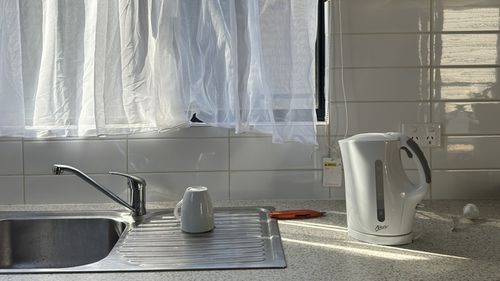
<div class="block-content"><div class="styles__Container-sc-1ylecsg-0 goULFa"><span>Plastic kettles are leaching microplastics into drinking water as they boil, researchers from the University of Queensland have found.</span></div></div><div class="block-content"><div class="styles__Container-sc-1ylecsg-0 goULFa"><span>The first few boils in a new kettle release the highest levels of nano and microplastics, but even after 150 boils, millions of particles are still being released, the research shows.</span></div></div><div class="block-content"><div class="styles__Container-sc-1ylecsg-0 goULFa"><span>Dr Elvis Okoffo is calling for consumer warnings on plastic kettles for people who may not realise their simple daily habit could be doing them harm.</span></div></div><div><div id="adspot-mobile-medium"></div></div><div class="block-content"><div class="styles__Container-sc-1ylecsg-0 goULFa"><strong><span>READ MORE:</span></strong><span> </span><a href="https://www.9news.com.au/finance/australia-money-health-insurance-extras-disappear/cc141f2b-167e-41e9-bdef-bf99789672ee" target="_blank"><strong><span>Millions of Aussies have just weeks to claim huge benefits</span></strong></a></div></div><div class="block-content"><div class="styles__Container-sc-1ylecsg-0 goULFa"><span>"This study provides evidence that plastic kettles can be a source of daily human exposure to nanoplastics and microplastics and that new plastic kettles release notable concentrations of these particles into water during boiling," Okoffo said.</span></div></div><div class="block-content"><div class="styles__Container-sc-1ylecsg-0 goULFa"><span>The research found the first boil in a new plastic kettle released almost 12 million nanoparticles per millilitre – which equates to almost 3 billion particles in an average 250ml cup of tea.</span></div></div><div class="block-content"><div class="styles__Container-sc-1ylecsg-0 goULFa"><span>After 150 boils, there were still 820,000 nanoparticles detected per millilitre, or 205 million per cup.</span></div></div><div><div class="OUTBRAIN" data-reactroot="" data-src="//www.9news.com.au/national/plastic-kettles-leaching-nano-plastics-into-water-queensland-research-news/b992f5c2-8654-4557-9db7-04aadeda125b" data-widget-id="AR_5"></div></div><div class="block-content"><div class="styles__Container-sc-1ylecsg-0 goULFa"><span>Simply rinsing a kettle before use did not achieve the same result as repeat boiling and discarding.</span></div></div><div class="block-content"><div class="styles__Container-sc-1ylecsg-0 goULFa"><span>"Many people may overlook or skip this step, highlighting the need for clearer product labelling and instructions," he said.</span></div></div><div class="block-content"><div class="styles__Container-sc-1ylecsg-0 goULFa"><span>"I would call on manufacturers, policymakers and regulators to inform consumers with safety guidelines or product labels warning about plastic particle release.</span></div></div><div class="block-content"><div class="styles__Container-sc-1ylecsg-0 goULFa"><span>"Although particle concentrations drop with repeated use, our research shows there is a continuous, low-level exposure risk.''</span></div></div><div class="block-content"><div class="styles__Container-sc-1ylecsg-0 goULFa"><span>He said further investigation was needed to better understand the human health implications of the exposure.</span></div></div><div class="block-content"><div class="styles__Container-sc-1ylecsg-0 goULFa"><span>"The study fills an important knowledge gap about how plastic products used in homes can contribute to daily plastic exposure and how small, practical changes in everyday routines can reduce exposure to plastics.</span></div></div><div class="block-content"><div class="styles__Container-sc-1ylecsg-0 goULFa"><span>"By combining better product design, improved labelling, and public awareness, we can help limit the amount of plastic entering both our bodies and the environment.''</span></div></div><div class="block-content"><div class="styles__Container-sc-1ylecsg-0 goULFa"><a href="https://www.nature.com/articles/s44454-025-00018-w" rel="" target="_blank" title="The research"><span>The research</span></a><span> also found hard tap water significantly reduced the amount of nanoplastic particles released, likely due to minerals forming a protective coating inside the kettle.</span></div></div><div class="block-content"><div class="styles__Container-sc-1ylecsg-0 goULFa"><a href="https://www.9news.com.au/national/how-to-follow-9news-digital/29855bb1-ad3d-4c38-bc25-3cb52af1216f" target="_blank"><strong><em><span>DOWNLOAD THE 9NEWS APP</span></em></strong></a><strong><em><span>: Stay across all the latest in breaking news, sport, politics and the weather via our news app and get notifications sent straight to your smartphone. Available on the</span></em></strong><span> </span><a href="https://apps.apple.com/au/app/9news/id1010533727" target="_blank"><strong><em><span>Apple App Store</span></em></strong></a><span> </span><strong><em><span>and</span></em></strong><span> </span><a href="https://play.google.com/store/apps/details?id=nineNewsAlerts.nine.com&hl=en_AU&pli=1" target="_blank"><strong><em><span>Google Play</span></em></strong></a><strong><em><span>.</span></em></strong></div></div>
Plastic kettles release millions of microplastics into every cuppa, study finds
Leave A Reply
Your email address will not be published.*